A practice ready to scale, an off-the-shelf stack at its ceiling.
“Before we started working together, the agency ran on a patchwork of tools that were never designed to talk to each other. Everything was manual. List building, pitching, outreach, reporting — all of it. The next step in the business felt heavy. Not exciting. Heavy.”
Scout's Agency — founded by Gabrielle “Scout” Maio nearly a decade ago — pioneered the Podcast Tour™ and has placed clients in 6,000+ podcast interviews across more than 400 tours. The pitching judgment, the curation, the host relationships: those are the practice's craft, and the team is exceptional at it.
The constraint wasn't the work, it was the workspace. Strategy, client intake, podcast research, outreach, and reporting lived across half a dozen separate tools — Monday, Google Sheets and Drive, a WordPress podcast search, Notion playbooks, Typeform intake — none of which were built to talk to each other. Monica, the agency's account manager, was spending real time stitching that context together by hand — time better spent on the curation and pitch work clients actually pay Scout's Agency for.
The brief was modest: rebuild the podcast database. The opportunity, once we mapped the workflow end-to-end, was bigger: connect the practice into one platform so the team could deliver an even higher level of curated service to more clients without expanding the team.
What we built.
Five interlocking pieces, all in one app — inputs feed a matching engine, which feeds an outreach pipeline, which produces a live audience graph.
- Podcast databaseNormalized 9,000+ shows. Audience size, topics, host info, contact paths. Refreshed automatically.
- Matching engineL1 enrichment → L2 scoring → L3 refinement. Surfaces high-fit candidates for every guest in seconds; the team drives the final selection.
- Strategic intakeCaptures bio, goals, audience, voice, dream shows, and sensitive topics in one structured handoff so the strategy work can start with the full picture.
- Outreach pipelinePitched → responded → booked, in one connected view. Sends through Gmail for the Podcast Tour™ (done-for-you) tier; for the Essentials (done-with-you) tier, the client's team runs outreach from their own inbox while the platform tracks state.
- Audience graphCumulative reach across booked shows. The metric clients actually want — finally a number a client can watch climb.
“What I got was a fully customized, proprietary portal built around our specific SOPs, our workflow, our framework — the way Scout's Agency actually operates. Not a generic template we'd have to adapt ourselves. It doesn't feel like software we're adapting to. It feels like infrastructure that was built for us.”
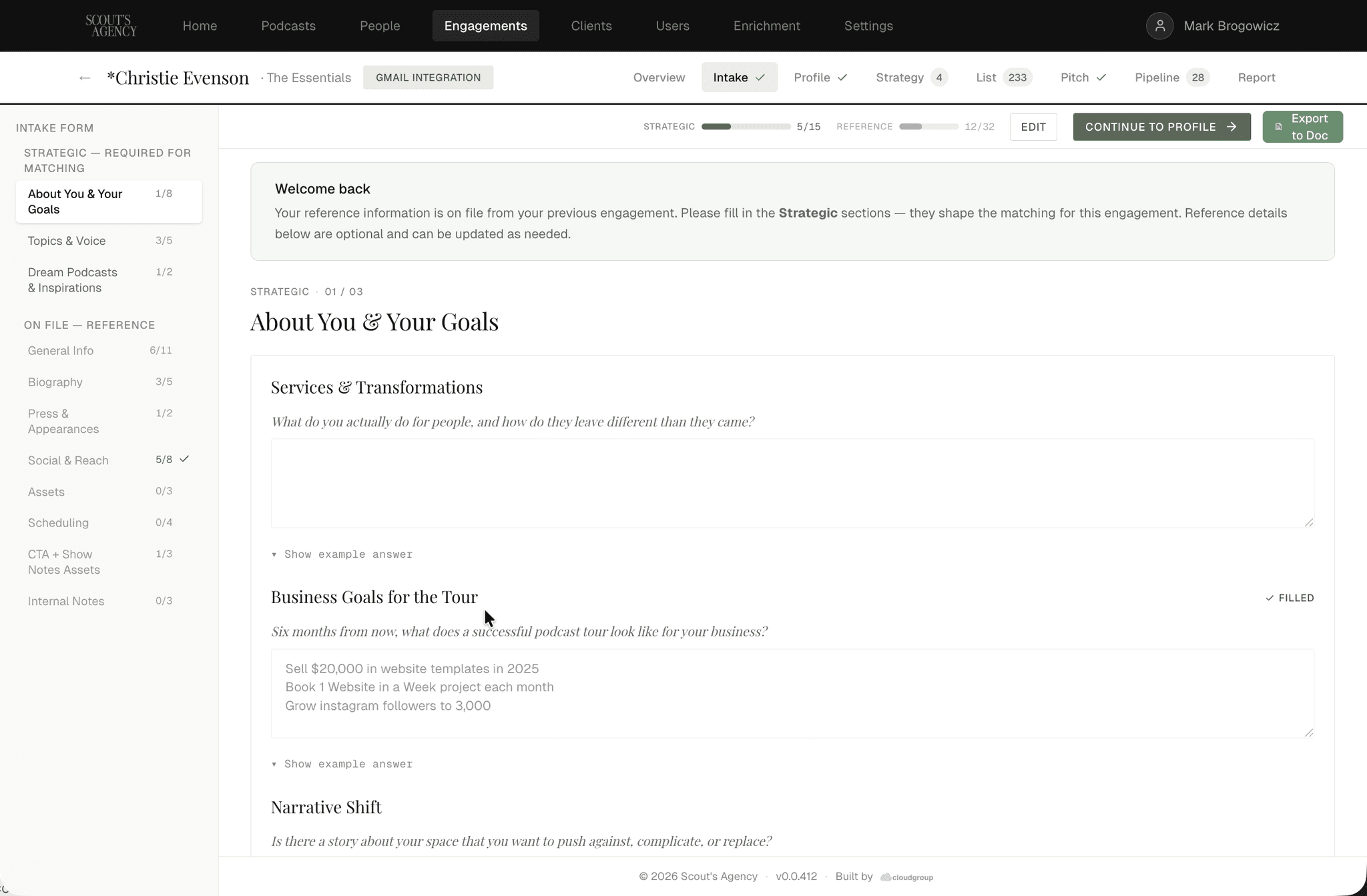
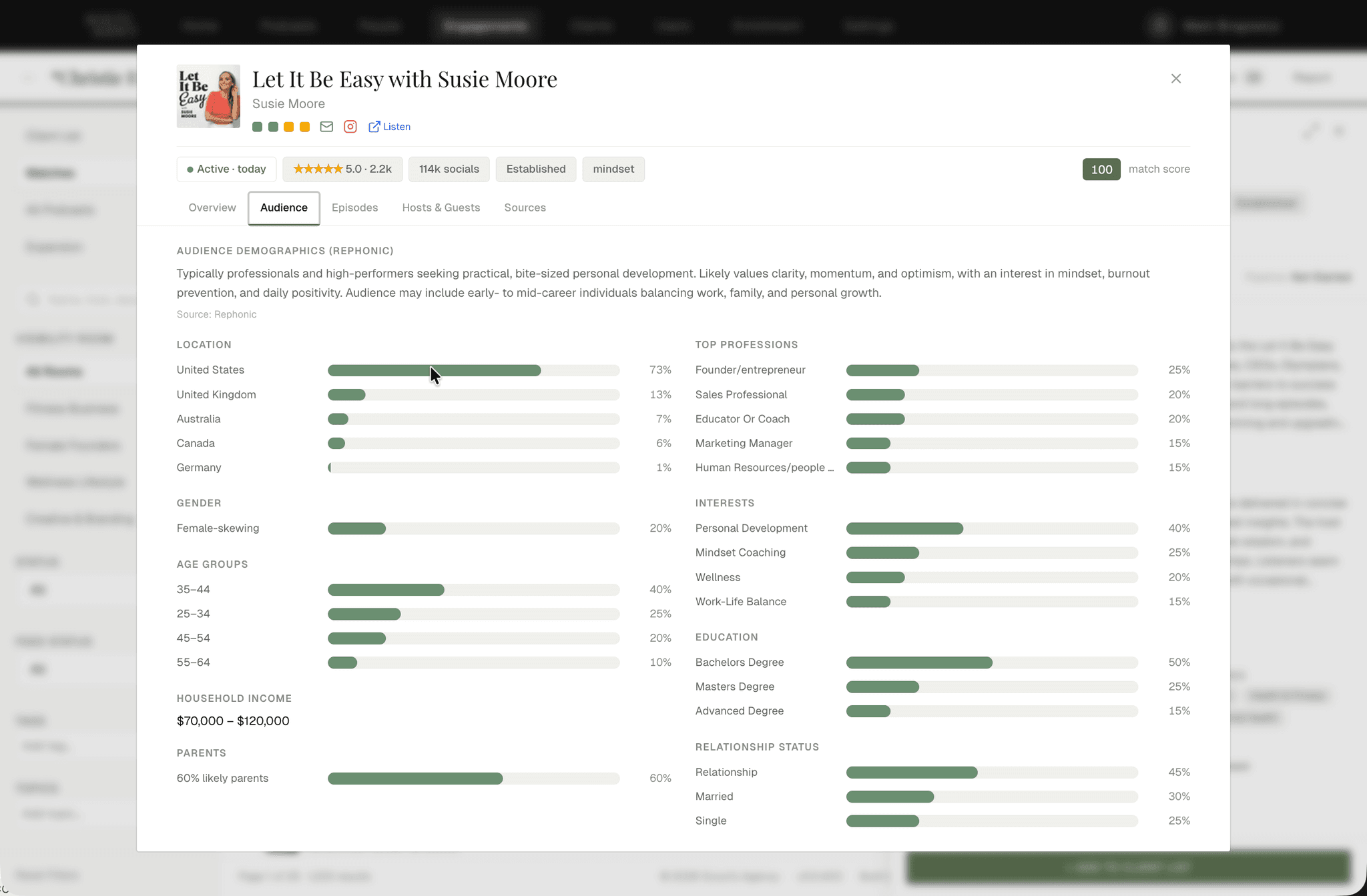
Architecture: a three-layer matching engine.
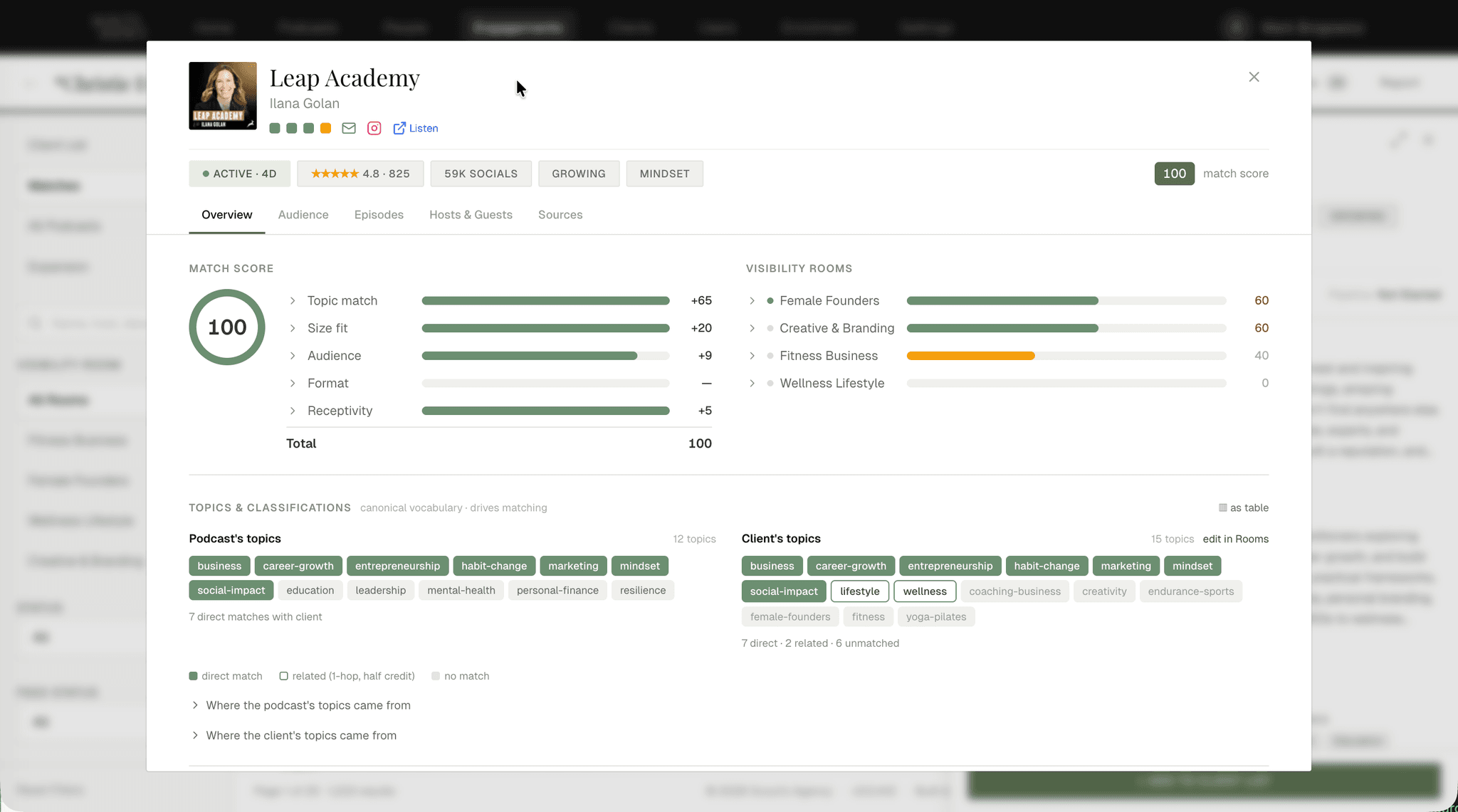
The matching engine — the second piece in the architecture above — earned a closer look. With the database expanding from a curated list to 9,000+ shows, the team needed a way to quickly surface the best-fit candidates from a much larger pool — without trading away the pitching and curation judgment that defines the practice. “Ask AI to do it” produces vague, unaccountable matches; what the work actually needed was structured signal a strategist could trust. We modeled it as three layers, each refining the answer of the one before:
The curated list is still the source of truth. The matching engine is a fast, re-runnable shortlist — the team still drives every selection, just with richer signal to work with.
Match scoring runs in the same UI. Below: the score breakdown for one show.
Outcomes.
“What used to take eight to twelve hours per client now takes about an hour. That's not a small efficiency gain. That's the difference between being able to serve five clients and being able to serve fifty.”
Beyond the numbers: Monica and the team can spend more time on the curation and pitch work clients actually pay Scout's Agency for. The matching engine widens the candidate pool well beyond what any team could review by hand. The audience graph gives clients a precise, live number to watch grow as placements compound. The Essentials offering — done-with-you — runs on the same platform, with a self-serve tier in the wings.
Economics.
Custom software for the price of a good annual SaaS bill.
A typical SaaS stack of six or seven tools runs ~$25–30K/year — forever, and growing as the team grows. A Large engagement is one-time. You own the code, and the platform compounds. The math stops working for SaaS bundles around month 18.
Scout, in her words.
A note from Scout, the week the platform went live. Lightly edited for length.
“Monica is exceptional at what she does, but so much of her time was going toward admin work that had nothing to do with her actual genius. The only obvious answer was to hire more people — another coordinator, more training, more oversight, more management. And that felt heavy.”
“If I had hired my way to scale, I might have 2x'd the business. This software opens the door to 10x. We can take on more clients without adding proportional headcount. Monica's role can evolve from execution-heavy to strategy-forward. We can build out new service tiers. We're already looking at a self-serve model that would let us work with clients at a completely different volume and price point than our current one-to-one model allows.”
“Every single conversation, I walked away thinking — I had no idea that was possible. The speed of iteration, the willingness to understand not just what I was asking for but why, and the ability to translate years of proprietary expertise into something that actually functions the way our best work functions — that surprised me every time.”
“I've already been telling people. I didn't wait to be asked. The week we launched I reached out to agency owners, entrepreneurs, founders — because I genuinely believe this is one of those moments where you either get ahead or you fall behind. If you're a business owner who hasn't had that conversation yet, you're leaving an enormous amount on the table.”
“The ceiling I was bumping up against is gone. And I haven't even found the new one yet.”
— Scout Maio, Founder · Scout's Agency